Friday, April 5, 2013

LJA: Quest for Civilization?


LJA: Quest for Civilization?
(Discriminating between True & False of Life)
Lalit K Kaul
The Truth of life may be death or easing in to another unknown form of life; the end point boundary condition for dynamics of life may or may not be free (unknown Truth), but in reaching that end point whether the life has been true or false is of utmost importance.
Whatever is found in Nature is bio degradable so that whatever is born out of it finally merges in to it in consonance with decay of matter and its assimilation by the very creator. The whole system is so well designed that it does not perpetuate a problem creation-solution finding circle. It is complete in itself sustaining innumerable species of fauna and flora, in addition to providing resources for human ‘civilizations’ since times unknown. The circle of emerging from and merging in to same Whole is flawless.
On the contrary, the contemporary human civilization revels in problem creation-solution finding circle; creates monsters that cannot be easily dispensed with; challenges decay of matter; is perpetually engaged in creating oligarchies that incessantly seek to arrogate all the resources/power on to itself to posit a single dimensional system on the entire humanity- be it in the sphere of politics, economics, education, art, science, and culture etc. etc. The modern societies have become like pre programmed robots that obey and implement game plan of various oligarchies. There is no reason to question the authenticity of their scientific claims and their inquisitiveness to uncover ‘Truth’, but what is unquestionably objectionable is that the whole premise of modern civilization is based on total exploitation of human societies that are essentially heterogeneous in character, but are being ruthlessly homogenized. This exploitation is so visible to naked eyes that this fact and truth is beyond debate. While the ‘Truth’ may or may not be uncovered one day, the dynamics of life in the mean time is being robbed of its truth with its existence being dictated to be ‘False’.
The God and the Electron:
The Nature and the entire universe is the expression of some unknown emotion regulated by its own laws defined by some unknown intelligence. If it is just a ‘coincidence’ yet it is the most fascinating and enchanting combination of that emotion and intelligence that is still as unfathomable as it was at its inception. In its scheme of things, ‘Time’ is ever continuous entity; not discrete and therefore any event dependent on it cannot be manipulated; therefore occurrence of various events in the universe cannot be manipulated by itself. The Nature and the universe is a heterogeneous entity; even if the occurrences within it are of random nature, yet they seem to have some kind of correlation between them making it ever sustainable and regenerative. In spite of the quantum of ‘violence’ imbibed within it, all species within it have their own defense mechanisms. Life exists in innumerable forms with each one having the freedom to sustain their lives even as death is inevitable. Life is ‘True’. This is the civilization as ordained by whatever created this most intricate, intelligent and awe inspiring system. For whatever may be the cause/reason/intelligence for its creation; I take this liberty to name it as ‘God’. L J A aspire post modern civilization to be like this?
Man is only a miniscule part of this system supposedly with highest level of intellectual capacity (comprehension) from among the innumerable species found in the universe. The architect of contemporary ‘modern civilization’/ robotic civilization; annihilator of pre modern civilizations; annihilator of Time and matter, and a great homogenizer having succeeded in creating a system that is the anti-thesis of ‘God’s’ civilization. The atomization of matter (birth of Electron) followed by discretization of Time and Space accrued to Man limitless manipulative capability that enabled him to disfigure any natural form and create his own desired form. Colonization is its premise and weapons of mass destruction the means to sustain it. Its creations have been essentially inefficient systems, predatory in character whose emergence have created all kinds of disorders and imbalances in ‘God’s’ civilization and yet are being flaunted as ‘science’ and ‘technological’ marvels. The robots in the system are intoxicated with the unlimited availability of electronic gadgets for ‘comforts of life’, even while the life itself is on the verge of becoming inanimate. The ‘haves’ continue to have it in plenty bordering hedonism while the ‘have-nots’ are continued to be deprived in plenty.
The ‘haves’ unquestionably believe in the existence of Electron as if they had seen it with their own eyes; the ‘have-nots’ believe as much in God as if they had seen HIM/HER/IT with their own eyes. One is deeply entrenched in ‘robotic civilization’ the other aspires to be in the lap of ‘God’s’ civilization.
The Limitation and the Victim:
The limitation of the premise of technology driven civilization is that it cannot accommodate entire Indian population in its scheme of things to afford them a kind of living that is availed by a very miniscule percentage of the whole populace, the victim is Lokavidhyadhar Samaj. Therefore the yardstick like BPL and the schemes like minimum wages/ employment are institutionalized not so much out their concern for the left-outs as for buying peace/stability to ensure uninhibited growth of the economies of the extant civilization. Since ‘growth & development’ has become synonym with building concrete jungles, ever spiraling real estate prices, and rise in BSE index; therefore augmentation of infrastructures to ensure transfer of Natural resources (wealth) to sustain it has acquired top most priority. It also ensures faster transit for labour from Lokavidhyadhar Samaj to within its fold. Employment of labour is also a political requirement otherwise the entire ‘development’ works can be easily automated to win accolades for ‘better economic sense’ since the profits would be maximized.
The entry points for labour from Lokavidhyadhar Samaj are slums and therefore they are allowed to come up and exist thereafter post regularization. Slums are seen as a gateway to better life (this perception being shared on both sides of the divide) for the generation next of the Lokavidhyadhar Samaj, the concomitant growth in crime rates notwithstanding. Ironically, higher crime rates also propel higher ‘growth’ rates because to tackle crime ‘law and order’ machinery is that much more strengthened what with more import of sophisticated arms and ammunitions to be nearly (if not completely) balanced out with more engineered exports- be it raw materials, finished goods, textiles, agricultural produce, etc.- by facilitating rupee devaluation.
The Divide:
The divide is civilization based; centralized over de-centralized concept of what all encompasses human endeavour; machine over man; automation over employment of millions of human brains and hands; concentrated intelligence over distributed mass intelligence; power to subjugate over power to self rule.
Is the as now vanquished civilization trying to re-emerge by re-grouping itself through Lokavidya Jan Andolan (L J A) or is it about extracting more favours from its adversary? It may be necessary to address to this question as that alone will decide what shape L J A takes in times to come. If the endeavour is to visualize (envision) post-modern civilization then LJA is bound to question many (or all) assertions (foundations) of modern civilization.
In my opinion the most important and profusely relevant subject for debate – if we are to question modern dispensation- is whether State’s interests should have precedence over those of individual/community/societies or should it be other way round? What kind of education, life, and property one envisages when terminologies like ‘Right to Education’, ‘Right to Life’, and ‘Right to Property’ etc. are glorified? ‘Right to Equality’, we are told is enshrined in our Constitution; in the context of such glaring disparities in our societies, of what relevance is the very Constitution on which is founded the Indian State, is a moot point to deliberate upon.
More importantly, population size cannot be made a scapegoat for gross inequalities that we witness in our land. That we are a densely populated nation, is a comparative statement; even as we are populated in whatever numbers we are, it is the duty of the state to either institutionalize such mechanisms that are capable of gainfully employing people or create opportunities wherein people employ themselves gainfully. Our Constitution has not put any limit on the population size that it is not applicable to populace outside that limit. Moreover those who talk of population size conveniently forget that they too have contributed to its numbers!


Right to Profession:
L J A can perhaps articulate its demand for ‘Right to Profession’; that is, one should be free to choose one’s profession. The professions like doing agriculture, weaving, spinning, cloth making and others like carpentry, etc. have been and continue to be family based, therefore they should be encouraged to continue in the family profession by providing for continuous up-gradation of associated infrastructures so that over a period of time their professions become viable enabling them to compete in the market; encouragement should be on the similar basis as has been going on for setting up of industries.
Right to Land’ without ‘Right to viable Agriculture’ does not make much of the sense because the land hawks are ever ready to grab the land what with lack of resources having made the land unproductive. If paucity of irrigation facilities has made a piece of land unproductive then these need to be provided by the State as the input in a similar fashion as it does for the industrialists. If the land by virtue of its ingredients cannot be made viable for agriculture such need to be excluded from “Right to Land’ slogan.
If one moves through areas like Ghaziabad, Noida, Gurgoan, and Faridabad, one comes across multiple monstrous sized multi storey housing apartments/ complexes that can easily house hundreds of moderate size villages. These housing monsters cannot survive without uninterrupted water supply. Therefore underground water sources in addition to river waters are provided for their consumption. This must be easily adding to a requirement of lacs & lacs of gallons of water per day consumed in the state-of-the-art bathrooms and kitchens. While the water was made available for ‘economic growth’, same was declared to be insufficient/ unavailable for agricultural purposes. If the owner of tillable land does not have resources to do agriculture he becomes a pawn in the hands of exploiters and loses his source of employment only to become a labourer. Thus an opportunity to choose his profession is denied to him and thereby all his energies, intellect, and decision making capabilities are brutally suppressed only to live a false life regulated by some unknown face.
How, where, and under what circumstances can populace of Lokavidhyadhar Samaj invest (empower) their talents; this question needs to be addressed to. It is sheer hunger that creates migrant labourers, it will continue until alternatives emerge; in the mean time, though, Lokavidhyadhar Samaj need to work towards an alternative set up in which their talents can find full expression. Search for an alternative set up can gain momentum only if the Samaj remains convinced that within modern dispensation it has no salvation, else it remains a false hope.
Call for planned infrastructure build up for farmers and karigar Samaj, by allocating meaningful funds in every Five Year Plan can perhaps be one of the important issues for L J A; combined with the resolve to reconstruct rural markets for their produce may turn out to be very powerful expression of their united opposition to the extant exploitative machinery.
Lalit Kaul


Monday, March 25, 2013

लोककला ज्ञान यात्रा 17 से 20 मार्च 2013

लोकाविद्याधर समाज का मेल-मिलाप 

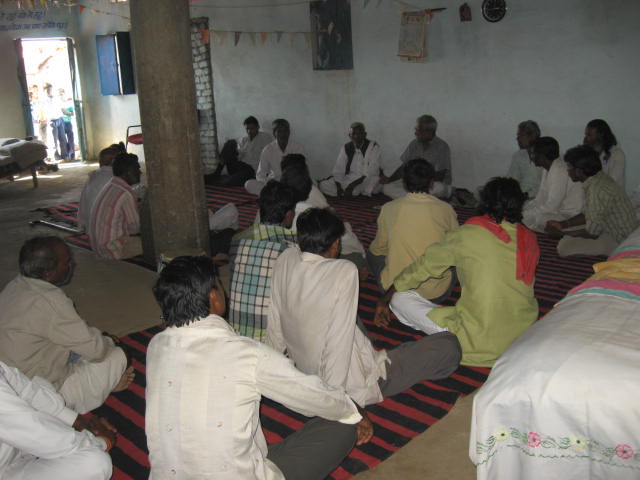
मालवा-निमाड़ क्षेत्र के आदिवासियों ने लोकविद्या जन आन्दोलन के तहत एक ऐसी ज्ञान यात्रा  निकाली जिसमें लोकाविद्याधर समाज का मेल-मिलाप उनके अपने ज्ञान के बल पर संभव हो पाया।  अपने ज्ञान को समाज में बांटते हुए  एकता का सन्देश देना अपने आप में एक अनूठा और सफल अनुभव रहा। 
संतों की वाणी पर जनवरी से ही इंदौर के ग्रामीण क्षेत्रों में आयोजन किये जा रहे हैं। ग्राम खुर्दी में जनवरी में, फिर फरवरी में कारीगरों की बस्ती महावर नगर और ग्राम आगरा में ऐसे आयोजन किये गये। इन आयोजनों से प्रेरित होकर दिनांक 17 मार्च से 20 मार्च 2013  तक एक ज्ञान यात्रा का आयोजन किया गया।  इस ज्ञान यात्रा में 25 गाँवों की मंडलियों ने भाग लिया। 

17 मार्च 2013
ग्रामविद्यालोक  कसरावद  - राजेन्द्र यादव जी के सहयोग से ग्राम कसरावद में दोपहर 12 बजे से शाम 7 बजे तक मंडलियों ने संत कबीरदास, मीराबाई के दर्शन को गाकर समाज के सामने प्रस्तुत किया। बाज़ार हाट का दिन होने से लोगों की भागीदारी अच्छी रही। यहाँ पर ग्रामविद्यालोक वायतेल  की लक्ष्मीबाई चौहान, शांति मारवाडा, अमरसिंह चौहान, नंदराम ठाकुर, अंतरसिंह चौहान, ने भी प्रस्तुति की . 
ग्राम कसरावद में सबको पक्की नौकरी लोकविद्या के बल पर मिलना चाहिए इस बात पर सभी ने एकमत होकर अपनी सहमति दी। 
18 मार्च 2013
ग्रामविद्यालोक मंडलेश्वर  - सबेरे नर्मदा मैय्या के पवित्र जल में स्नान करने के बाद शालिबाना आश्रम में भोजन करके मंडलेश्वर में आयोजन की तयारी प्रारंभ की गयी। यहाँ अधिकारीयों ने अनुमति नहीं दी तो यह तय किया गया की इसे लेकर परेशान न होकर ग्राम महेश्वर में आयोजन कर लिया जाये। महेश्वर में भवानी माता के मंदिर पर अहिल्या बाई बस स्टैंड के पास दोपहर 1 बजे से शाम 5 बजे तक संत सबद और लोकविद्या सत्संग चला। महेश्वर के निवासियों ने भी भागीदारी की। बाबूलाल, राजीव चोके, किशोर मेरठ, जगदीश मेकेनिक और महेश रणसोरे ने महेश्वर में एक बार पुनः आयोजन करने की तैयारी  दिखाई और यहाँ के ग्राम गवला, ग्राम इटावदी , ग्राम देवर की मंडलियों को सम्मिलित करने का सुझाव दिया।

18 मार्च 2013
ग्रामविद्यालोक ठीकरी  - शरद महाजन के सहयोग से ठीकरी में रात्रि 8 बजे से 12 बजे तक संत सबद के मार्फ़त लोकविद्या सत्संग हुआ। नेमा  धर्मशाला में पड़ाव व भोजन प्रबंध शरद महाजन ने किया। ठीकरी में दिनेश धनगर चाय का ठेला लगाते हैं। उन्होंने इस आयोजन को करने में पहल ली। कमल राठौर, मोतीलाल यादव, प्रशांत महाजन का भी सहयोग मिला। ठीकरी में कुछ लोगों ने दूसरे दिन यह प्रतिक्रिया जाहिर की कि इन आदिवासियों से ही समाज को नई  दिशा मिल सकती है। कार्यक्रम बड़े स्तर  पर पुनः आयोजित करने की मंशा प्रकट की गई।


19 मार्च 2013
ग्रामविद्यालोक कुक्षी - कुक्षी के सामाजिक कार्यकर्ता एवं लोकहित संघर्ष समिति कुक्षी के महिमाराम पाटीदार के सहयोग से सूर्या  टाकिज के पास संत सबद के साथ लोकविद्या सत्संग दिन में 12 बजे से 5 बजे तक संपन्न हुआ। हाट बाज़ार का दिन होने से और मुख्य बाज़ार में कार्यक्रम होने से इसमें बड़ी संख्या में लोगों की भागीदारी रही। मंच के पास भारी संख्या में लोग इकट्ठा हो गये. लोकविद्या दर्शन को लोग बड़े ध्यान से सुन रहे थे. तभी किसी अधिकारी ने सरकारी परमिशन की बात उठाई। कुछ समय कार्यक्रम बंद  रखा गया लेकिन उपस्थित लोगों के आग्रह पर इसे फिर से शुरू कर दिया।
अय्यूब भाई ने खूब सहयोग दिया।  महेश कामदार ने बईदा  गाँव में रात्रि में कार्यक्रम करने का आग्रह किया। महिमाराम पाटीदार ने कुक्षी में एक और बड़े कार्यक्रम को करने की बात रखी। लोकविद्या के बल पर सबको पक्की नौकरी मिलना चाहिए इस मुद्दे पर सहमति बनी और अन्य मुद्दों पर भी बात हुई।

19 मार्च 2013
ग्रामविद्यालोक चिकली  - चिकली में शाम 6 से रात्रि 9 बजे तक बैठक आयोजित की गयी। लोकविद्या समन्वय  समूह चिकली के मगन सिंह बघेल के घर पर भोजन किया गया। बैठक में चिकली के कदम सिंह जामोद व अन्य ने अच्छा सहयोग किया।

कई एक मंडलियों के सदस्यों को गेहूं की कटाई का समय होने से जल्दी गाँव लौटना था। बैठक में यह तय किया गया कि चूँकि ज्यादातर मंडलियाँ लौटना चाहती हैं इसलिए ज्ञान यात्रा को चिकली तक ही सीमित कर दिया जाये।
अगले कार्यक्रमों को आयोजित करने के उद्देश्य से ग्रामविद्यालोक गुजरी में 10 अप्रैल 2013 को एक बैठक आयोजित करने की घोषणा की गयी।


20 मार्च 2013
ग्रामविद्यालोक भकलाई - रात्रि के सफ़र के बाद कुछ मंडलियों ने ग्राम भकलाई में सत्संग किया। यहाँ भोजन किया और यहाँ ज्ञान यात्रा का समापन हुआ।

लोकविद्या समन्वय समूह के संजीव दाजी और विद्या आश्रम सारनाथ से भारतीय  किसान यूनियन वाराणसी मंडल के सचिव दिलीप दिली ने इस पूरी ज्ञान यात्रा के संयोजन में सक्रिय भूमिका निभाई।

लोकविद्या जन आन्दोलन अपने को कबीर, रैदास, मीरा, सूरदास तुकाराम, नानक, नरहरी, जनाबाई, घासीदास, तुकडोजी और  गाडगे महाराज जैसे संतों की परम्परा में लोकविद्याधरों के ज्ञान आन्दोलन के रूप में देखता है। आज के झूठ और पाखंड से मुकाबले और सबके लिए न्याय के लिए यह आन्दोलन लोकविद्या के बल पर सबके लिए पक्की आय और सरकारी कर्मचारी के बराबर वेतन की मांग करता है. लोकविद्या दृष्टिकोण वह रास्ता बताता है जिससे यह संभव बनाया जा सकता है।

लोकविद्या समन्वय समूह
1924-डी , सुदामा नगर, इंदौर
मो. : 9926426858


Saturday, March 16, 2013

On Truth ...and Experiments with It.

      It is only natural that one worries about something which is most self-evident to all, because it is most likely that a number of things of ordinary life will be affected by it. I am referring to the worst casualty of the flux of transformations in the sphere of knowledge - that of TRUTH. It seems that people take great pains to assert that they have no hope of getting at the truth of anything or to understand what it means if it is stated that something is true. This condition is as much applicable to the stock brokers as to academics, the topmost nuclear physicist of the day (working on the Large Hadron Collider in Geneva hoping to unravel the secrets of the 'real' fundamental constituents of matter ) or the bestmathematician ( who accept a computation based proof of Fermat's last theorem). The same is true of the fate of the biologists who propound the theory of a single ancestor for evolution or single biological mother for all human beings.

     What is evident is that while rationality may be used to create any specific device or prove any assertion, this rationality does not really add up to something anywhere close to a SYSTEM - a system believable, which enable ordinary people to be practical in peacefully relying on the learned oracles. No! Now, people consider the experts to possess the knowhow to do certain things, but believe in none of the 'explanations' advanced there of for what is 'really' happening. For example, if the flood water is entering the gates of the walled town from the northern gate, they would want the best engineers to build a wall to prevent the deluge, but do not believe that the flood was caused by any understandable effect of global warming or some such cosmic causation!

     Of course, the complexity of rationality ( devices, connexions, algorithms ) demands that the new education be primarily geared to generate sufficient number of lay practitioners who can carry out the subroutines without demanding an explanation. You need an army of people trained in biology and techniques of nano-techhnology to run the new machines and enterprises. And the educational institutions seem to say : these days students can not afford to go after philosophy and explanations, which, any way are not there! In fact one can listen to the tune : Well, tomorrow it will be a different explanation. Surely, this explanation serves some purpose of the day, but in trying to understand all knowledge, explanations from the earlier epoch,  how TRUE does it sound today?

    Does this epistemic bootstrapping point to some deep law on human  reason, regarding something what one may call social reason, distributed reason - some such non-standard idea of TRUTH? That is, do we have something like some inherent averaging process ( somewhat like the Ensemble average in the sense of Boltzmann ) for arriving at truth which replaces in a definite sense the Time average ( traditional knowledge, ordinary life support, historical etc. of the earlier human life)? Moreover, there may be possibly even some idea of stability, evolutionary, which corresponds to the idea of Equilibrium ( for which the two averages are same according to Boltzmann). And that this opens a responsible window for the new knowledge technologies. And can it be that the thesis about science generally losing command and control of knowledge is to seen in this light of the subtle shift of how to experiment with truth?

     However, a deeper reflection may suggest that science has always been so. Sir Isaac Newton was absolutely unable to understand chemistry on the basis of his understanding of his laws of mechanical and gravitational ( having a mechanical explanation ) motion and believed in alchemy - the medieval chemistry of turning base metals into gold. The latter , not unlike sorcery and magic, demanded a level of belief in the person learning to performing it. Newton's Christian faith and the practices of devout Christians of that period in England came to his rescue. In fact the life histories of great scientists demonstrates sufficiently persuasively (for ordinary people at least ) the fact that science is rarely in command and control as far as creativity is concerned. The Kantian command and control of science is the construction of the equivalent of the Divine Right of Kings  in England or agency of the Pope in Christianity for democracy, the thought that command and control is to sustain political order. Perhaps one does not have to possess the directness of Henri Poincaré to see that.


    Now comes the question: Assuming that Truth is undergoing such transformation in Science ( something akin to what was definitely an unfinished statement above), what is the situation in Lokavidya?


Surendran K.K.
( Note: To be made more precise after receiving readers' comments)

Tuesday, March 5, 2013

निमाड़ में लोकविद्या कला यात्रा - 17-23 मार्च 2013

अलीराजपुर में होली के अवसर पर भगोरिया के नाम से एक बहुत बड़ा आदिवासी मेला-उत्सव होता है. इस वर्ष  लोकविद्या जन आन्दोलन की ओर से इस उत्सव में शामिल होने का कार्यक्रम बनाया गया है.17 मार्च को मंडलेश्वर से शुरू करके एक लोकविद्या कला यात्रा विभिन्न जिलों से होती हुई सोंडवा, अलीराजपुर पहुँच कर वहां भगोरिया में शामिल होगी। इस यात्रा के लिए कई गांवों की कबीर गायकी की मंडलियाँ शामिल होंगी। लगभग 80 कलाकार शामिल होने की उम्मीद है जो एक गाँव से दूसरे गाँव  कबीर गायकी के कार्यक्रम करते चले जायेंगे और इन कार्यक्रमों में लोकविद्या और उसकी शक्ति पर चर्चाएं होंगी । कार्यक्रम नीचे दिया हुआ है. 


तारीख (मार्च 2013)          गाँव                     जिला 
   
 17                               मंडलेश्वर             खरगौन
 18 सुबह                      कसरावद              खरगौन     
 18  रात                       अंजड                    बडवानी 
 19 सुबह                       कुक्षी                      धार 
 19  रात                        चिकली                   धार 
 20                               सोंडवा               अलीराजपुर 
 21                               सोंडवा                       "
 22                               वालपुर                      "
 23                               बाघ टांडा                   "

यह इस कला यात्रा में शामिल होने का खुला निमंत्रण है. हमसे संपर्क करें। 

लोकविद्या समन्वय समूह, इंदौर 
09926426858
                       

Monday, March 4, 2013

Lokavidya Jan Andolan (LJA) - One More Step

Mumbai Meeting Expands LJA Scope


The meeting in Mumbai on 23-24 Feb. 2013, helped to consolidate the activities of LJA during last one year, mainly since the Sevagram meeting on 17th March 2012. Whereas there was good discussion on the Lokavidya philosophy, the details from the various regions of activity got reported. Building of Lokavidya Ashrams and initiating dialogue on Lokavidya Tana-Bana were fresh high lights that infused a creative strand and a sense of looking beyond what one keeps doing organizationally. The meeting attended by about 40 persons concluded on a forward looking and imaginative note.


LJA Organization - The Regions
The program adopted in the November 2011 Varanasi Conference was implemented through the last year. There was the Darbhanga Conference for Bihar state on 31st March-1st April 2012, the Chirala Conference for Andhra Pradesh on 24-25 May 2012, the Singrauli Conference for Madhya Pradesh on 28-30 September 2012 and the Indore regional event on 19-20 January 2013. Dialogue on Lokavidya Tana-Bana was initiated at Varanasi through a large meeting at Vidya Ashram on 19-20 February 2012. The LJA worked very closely every where with peasants in their struggles, which were often to save their lands from forced acquisition. It also tried to develop links with artisan and adivasi groups and organizations. All this got reported concurrently on this blog.

In this meeting in Mumbai the report from Varanasi by Premalata Singh underlined the integral connection of the LJA work in Uttar Pradesh with Bharatiya Kisan Union and attempts to build lokavidya relations with weavers and other artisans. A state level LJA Meet jointly with BKU U.P. is proposed for November this year.
Work in Singrauli has taken some strides forward after the state level convention of LJA held there in end September 2012. Ravishekhar reported on their present activity in far flung areas and amid those displaced by the continuous stream of new private power companies. It is planned to publish a monthly paper from Lokavidya Ashram in Singrauli. They also plan to undertake a Lokavidya tour of the state jointly with Indore activists and Vidya Ashram Varanasi. It is proposed to have a state level lokavidya activists meeting in Bhopal on 22-23 June 2013.
Sanjeev Daji reported from the Indore region. Here the highlights include a Bazar Modo-Lokavidya Bazar Banao campaign, Gyan Panchayats on the issue of displacement rampant there due to Delhi-Mumbai Corridor and expanding industrial-educational-habitat activity, a fresh program of loka gayaki mainly with Kabir mandalis and a continuous dialogue with the somewhat socially inclined middle classes of Indore city. Kisan-Adivasi unity forms the general basis and the direction giving context of LJA work in this region.

Mohan Rao and Narayan Rao  talked about the organizational activity among artisans around Chirala and Vijaywada and the publication of Lokavidya Prapancham, a Telugu periodical, from Hyderabad. Krishnarajulu gave a picture of displacement of peasants and fishermen along coastal Andhra Pradesh and the LJA connection with it, particularly with work in Sompeta, Shrikakulam and Nellore.

Lokavidya Ashram

Dilip Kumar from Varanasi, Ekta from Singrauli and Sanjeev from Indore reported on the building of Lokavidya Ashrams in their regions. Dilip also talked about the possibility of building a Lokavidya Ashram on the bank of the Son river in Anooppur (M.P.) jointly with Kabir panthis there.

Lokavidya Tana-Bana

Friends from the world of art in Mumbai, Pune and Chennai had joined for the debate on Lokavidya Tana-Bana. They included a shahir, a designer, a singer,a cinema director, a TV shows and short films director,  a cinema script writer, a theater person, a sculptor and a university lok-kala teacher. The idea of Lokavidya Tana-Bana as the space of relationships and connectivity among the lokavidyadhar samaj was presented and a discussion initiated on how this could be the critical space where the artists could contribute to building of new imagination and initiative in return to what they incessantly take from the people. They all spoke. The attempt was to focus on the possibility of artistic activity giving new and politically significant meaning to Lokavidya Tana-Bana. It was felt that this is a new dialogue and there is need to explore the variety of forms that this dialogue can take.
Kelai Draupadi, a Tamil film by Sashikanth, was screened. It presents a forgotten aspect of the tradition of struggles in this country, struggles for negotiating peace settlements with aggressors.


Lokavidya Darshan 

A participatory discussion took place at the beginning of the meeting on the question of political imagination that may derive from the lokavidya stand-point.Among many questions raised while initiating this relatively philosophical discussion, two got the focus.  One, whether there was a clear need again to think in terms of 'swaraj' and not in terms of 'democracy' ? And two, what is the nature of our engagement - are we engaged in a war to finish off the present and build the future anew OR is it a struggle based negotiation for a peaceful settlement through which the people can regain their lost initiative and also new opportunities for fresh initiative ? Builders of the lokavidya darshan and Vidya Ashram present in the meeting came forward to express deeper thought on people, change and the knowledge loci in society. This was a discussion taking place for the first time in the context of Lokavidya Jan Andolan and it was felt that attempts should be made to get more and more people to participate in it.

In the End 

The following emerged through these meetings.
  • All the regions of activity shall have full autonomy in their work. It is important that activists from different regions collaborate for work. 
  • Definite income for everyone based on lokavidya work and emoluments equal to that of a government employee, emerged as the idea around which extensive coordination within LJA can be achieved. Concrete methods of doing this may be envisaged in relation to the ideas and work going on with respect to this in different regions. 
  • Peasants' struggles are steadily on the rise across the country. They exhibit great variety and all feel the need of cooperation from and coordination with others. Coordination of peasants' struggles all over the country is a challenge that LJA needs to accept. 
  • The building of Lokavidya Ashrams should continue. 
  • Lokavidya Tana-Bana provides a new location for experiments and new enterprise with and for different types of artists. 
  • Vidya Ashram Varanasi remains the secretariat of LJA, until concrete proposals are received from some other place. 

Vidya Ashram